Word and Number and Symbol and Art and Geometric Pattern Recognition Middle School Book
Geometry (from Ancient Greek γεωμετρία ( geōmetría ) 'land measurement'; from γῆ ( gê ) 'world, state', and μέτρον ( métron ) 'a measure') is, with arithmetic, i of the oldest branches of mathematics. It is concerned with properties of space that are related with distance, shape, size, and relative position of figures.[one] A mathematician who works in the field of geometry is chosen a geometer.
Until the 19th century, geometry was almost exclusively devoted to Euclidean geometry,[a] which includes the notions of betoken, line, airplane, distance, bending, surface, and curve, as cardinal concepts.[2]
During the 19th century several discoveries enlarged dramatically the scope of geometry. Ane of the oldest such discoveries is Gauss' Theorema Egregium ("remarkable theorem") that asserts roughly that the Gaussian curvature of a surface is contained from any specific embedding in a Euclidean space. This implies that surfaces can exist studied intrinsically, that is, equally stand up-alone spaces, and has been expanded into the theory of manifolds and Riemannian geometry.
Later in the 19th century, it appeared that geometries without the parallel postulate (non-Euclidean geometries) can be adult without introducing any contradiction. The geometry that underlies full general relativity is a famous application of non-Euclidean geometry.
Since then, the scope of geometry has been greatly expanded, and the field has been divide in many subfields that depend on the underlying methods—differential geometry, algebraic geometry, computational geometry, algebraic topology, detached geometry (also known as combinatorial geometry), etc.—or on the properties of Euclidean spaces that are overlooked—projective geometry that consider simply alignment of points but not distance and parallelism, affine geometry that omits the concept of bending and distance, finite geometry that omits continuity, and others.
Originally developed to model the physical world, geometry has applications in virtually all sciences, and also in art, compages, and other activities that are related to graphics.[3] Geometry also has applications in areas of mathematics that are patently unrelated. For example, methods of algebraic geometry are cardinal in Wiles'south proof of Fermat'south Last Theorem, a problem that was stated in terms of elementary arithmetics, and remained unsolved for several centuries.
History

A European and an Arab practicing geometry in the 15th century
The earliest recorded beginnings of geometry tin can be traced to ancient Mesopotamia and Egypt in the 2d millennium BC.[4] [5] Early on geometry was a collection of empirically discovered principles apropos lengths, angles, areas, and volumes, which were developed to meet some practical need in surveying, construction, astronomy, and various crafts. The primeval known texts on geometry are the Egyptian Rhind Papyrus (2000–1800 BC) and Moscow Papyrus (c. 1890 BC), and the Babylonian clay tablets, such as Plimpton 322 (1900 BC). For example, the Moscow Papyrus gives a formula for computing the volume of a truncated pyramid, or frustum.[six] After clay tablets (350–50 BC) demonstrate that Babylonian astronomers implemented trapezoid procedures for computing Jupiter's position and motion within time-velocity space. These geometric procedures predictable the Oxford Calculators, including the mean speed theorem, past 14 centuries.[7] South of Egypt the ancient Nubians established a arrangement of geometry including early versions of lord's day clocks.[eight] [9]
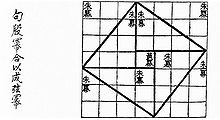
In the seventh century BC, the Greek mathematician Thales of Miletus used geometry to solve bug such equally computing the height of pyramids and the distance of ships from the shore. He is credited with the first apply of deductive reasoning practical to geometry, by deriving four corollaries to Thales' theorem.[10] Pythagoras established the Pythagorean School, which is credited with the kickoff proof of the Pythagorean theorem,[xi] though the statement of the theorem has a long history.[12] [13] Eudoxus (408–c. 355 BC) developed the method of exhaustion, which allowed the adding of areas and volumes of curvilinear figures,[14] equally well as a theory of ratios that avoided the problem of incommensurable magnitudes, which enabled subsequent geometers to brand meaning advances. Around 300 BC, geometry was revolutionized past Euclid, whose Elements, widely considered the most successful and influential textbook of all fourth dimension,[15] introduced mathematical rigor through the axiomatic method and is the primeval example of the format still used in mathematics today, that of definition, axiom, theorem, and proof. Although most of the contents of the Elements were already known, Euclid arranged them into a single, coherent logical framework.[sixteen] The Elements was known to all educated people in the West until the middle of the 20th century and its contents are still taught in geometry classes today.[17] Archimedes (c. 287–212 BC) of Syracuse used the method of exhaustion to calculate the area under the arc of a parabola with the summation of an infinite series, and gave remarkably accurate approximations of pi.[xviii] He also studied the spiral bearing his name and obtained formulas for the volumes of surfaces of revolution.
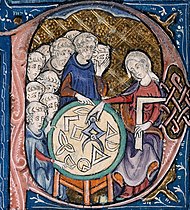
Woman teaching geometry. Illustration at the beginning of a medieval translation of Euclid'due south Elements, (c. 1310).
Indian mathematicians also made many important contributions in geometry. The Satapatha Brahmana (3rd century BC) contains rules for ritual geometric constructions that are like to the Sulba Sutras.[19] According to (Hayashi 2005, p. 363), the Śulba Sūtras incorporate "the earliest extant verbal expression of the Pythagorean Theorem in the globe, although it had already been known to the Old Babylonians. They contain lists of Pythagorean triples,[twenty] which are detail cases of Diophantine equations.[21] In the Bakhshali manuscript, there is a handful of geometric problems (including problems about volumes of irregular solids). The Bakhshali manuscript also "employs a decimal place value organization with a dot for null."[22] Aryabhata'south Aryabhatiya (499) includes the computation of areas and volumes. Brahmagupta wrote his astronomical work Brāhma Sphuṭa Siddhānta in 628. Chapter 12, containing 66 Sanskrit verses, was divided into two sections: "basic operations" (including cube roots, fractions, ratio and proportion, and barter) and "applied mathematics" (including mixture, mathematical series, plane figures, stacking bricks, sawing of timber, and piling of grain).[23] In the latter section, he stated his famous theorem on the diagonals of a cyclic quadrilateral. Affiliate 12 likewise included a formula for the expanse of a circadian quadrilateral (a generalization of Heron'southward formula), too equally a complete description of rational triangles (i.e. triangles with rational sides and rational areas).[23]
In the Middle Ages, mathematics in medieval Islam contributed to the development of geometry, especially algebraic geometry.[24] [25] Al-Mahani (b. 853) conceived the idea of reducing geometrical bug such as duplicating the cube to problems in algebra.[26] Thābit ibn Qurra (known as Thebit in Latin) (836–901) dealt with arithmetics operations applied to ratios of geometrical quantities, and contributed to the development of analytic geometry.[27] Omar Khayyám (1048–1131) constitute geometric solutions to cubic equations.[28] The theorems of Ibn al-Haytham (Alhazen), Omar Khayyam and Nasir al-Din al-Tusi on quadrilaterals, including the Lambert quadrilateral and Saccheri quadrilateral, were early results in hyperbolic geometry, and along with their alternative postulates, such as Playfair's axiom, these works had a considerable influence on the evolution of non-Euclidean geometry among later European geometers, including Witelo (c. 1230–c. 1314), Gersonides (1288–1344), Alfonso, John Wallis, and Giovanni Girolamo Saccheri.[ dubious ] [29]
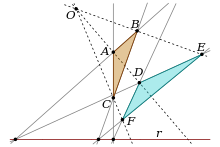
In the early on 17th century, in that location were two of import developments in geometry. The first was the creation of analytic geometry, or geometry with coordinates and equations, past René Descartes (1596–1650) and Pierre de Fermat (1601–1665).[30] This was a necessary forerunner to the development of calculus and a precise quantitative scientific discipline of physics.[31] The second geometric development of this period was the systematic study of projective geometry past Girard Desargues (1591–1661).[32] Projective geometry studies properties of shapes which are unchanged under projections and sections, especially as they relate to artistic perspective.[33]
Two developments in geometry in the 19th century inverse the way it had been studied previously.[34] These were the discovery of non-Euclidean geometries by Nikolai Ivanovich Lobachevsky, János Bolyai and Carl Friedrich Gauss and of the conception of symmetry as the central consideration in the Erlangen Plan of Felix Klein (which generalized the Euclidean and non-Euclidean geometries). Two of the master geometers of the time were Bernhard Riemann (1826–1866), working primarily with tools from mathematical assay, and introducing the Riemann surface, and Henri Poincaré, the founder of algebraic topology and the geometric theory of dynamical systems. As a result of these major changes in the conception of geometry, the concept of "space" became something rich and varied, and the natural background for theories as dissimilar equally complex analysis and classical mechanics.[35]
Main concepts
The following are some of the most of import concepts in geometry.[2] [36] [37]
Axioms

Euclid took an abstract arroyo to geometry in his Elements,[38] one of the most influential books ever written.[39] Euclid introduced certain axioms, or postulates, expressing primary or self-axiomatic properties of points, lines, and planes.[twoscore] He proceeded to rigorously deduce other backdrop by mathematical reasoning. The characteristic characteristic of Euclid's approach to geometry was its rigor, and information technology has come to be known every bit evident or synthetic geometry.[41] At the start of the 19th century, the discovery of non-Euclidean geometries past Nikolai Ivanovich Lobachevsky (1792–1856), János Bolyai (1802–1860), Carl Friedrich Gauss (1777–1855) and others[42] led to a revival of interest in this discipline, and in the 20th century, David Hilbert (1862–1943) employed evident reasoning in an effort to provide a modern foundation of geometry.[43]
Objects
Points
Points are more often than not considered cardinal objects for building geometry. They may be defined past the properties that thay must have, as in Euclid's definition every bit "that which has no office",[44] or in synthetic geometry. In modern mathematics, they are generally defined as elements of a prepare called infinite, which is itself axiomatically defined.
With these modernistic definitions, every geometric shape is defined equally a set of points; this is non the example in synthetic geometry, where a line is another cardinal object that is not viewed every bit the gear up of the points through which it passes.
Notwithstanding, at that place has modern geometries, in which points are not archaic objects, or even without points.[45] [46] Ane of the oldest such geometries is Whitehead'southward point-free geometry, formulated by Alfred Due north Whitehead in 1919–1920.
Lines
Euclid described a line as "breadthless length" which "lies equally with respect to the points on itself".[44] In modern mathematics, given the multitude of geometries, the concept of a line is closely tied to the manner the geometry is described. For instance, in analytic geometry, a line in the plane is often defined as the set of points whose coordinates satisfy a given linear equation,[47] merely in a more abstruse setting, such as incidence geometry, a line may be an independent object, distinct from the set up of points which lie on information technology.[48] In differential geometry, a geodesic is a generalization of the notion of a line to curved spaces.[49]
Planes
In Euclidean geometry a plane is a apartment, 2-dimensional surface that extends infinitely;[44] the definitions for other types of geometries are generalizations of that. Planes are used in many areas of geometry. For instance, planes can exist studied as a topological surface without reference to distances or angles;[50] information technology can be studied equally an affine space, where collinearity and ratios tin be studied but not distances;[51] information technology can exist studied as the complex plane using techniques of complex assay;[52] then on.
Angles
Euclid defines a aeroplane angle as the inclination to each other, in a plane, of two lines which meet each other, and practice not prevarication straight with respect to each other.[44] In mod terms, an angle is the figure formed by two rays, called the sides of the angle, sharing a common endpoint, called the vertex of the angle.[53]

Acute (a), obtuse (b), and directly (c) angles. The astute and birdbrained angles are besides known as oblique angles.
In Euclidean geometry, angles are used to study polygons and triangles, as well as forming an object of study in their own right.[44] The report of the angles of a triangle or of angles in a unit circumvolve forms the footing of trigonometry.[54]
In differential geometry and calculus, the angles betwixt plane curves or space curves or surfaces can be calculated using the derivative.[55] [56]
Curves
A curve is a one-dimensional object that may be straight (like a line) or non; curves in ii-dimensional space are called plane curves and those in 3-dimensional space are chosen space curves.[57]
In topology, a bend is defined by a role from an interval of the real numbers to some other space.[50] In differential geometry, the same definition is used, simply the defining function is required to be differentiable [58] Algebraic geometry studies algebraic curves, which are defined every bit algebraic varieties of dimension one.[59]
Surfaces

A sphere is a surface that can be defined parametrically (past x = r sin θ cos φ, y = r sin θ sin φ, z = r cos θ) or implicitly (past x two + y 2 + z 2 − r two = 0.)
A surface is a two-dimensional object, such as a sphere or paraboloid.[sixty] In differential geometry[58] and topology,[50] surfaces are described past ii-dimensional 'patches' (or neighborhoods) that are assembled past diffeomorphisms or homeomorphisms, respectively. In algebraic geometry, surfaces are described by polynomial equations.[59]
Manifolds
A manifold is a generalization of the concepts of curve and surface. In topology, a manifold is a topological space where every bespeak has a neighborhood that is homeomorphic to Euclidean infinite.[50] In differential geometry, a differentiable manifold is a infinite where each neighborhood is diffeomorphic to Euclidean space.[58]
Manifolds are used extensively in physics, including in full general relativity and string theory.[61]
Length, area, and book
Length, area, and book draw the size or extent of an object in one dimension, ii dimension, and 3 dimensions respectively.[62]
In Euclidean geometry and analytic geometry, the length of a line segment can often be calculated by the Pythagorean theorem.[63]
Surface area and book can be defined as cardinal quantities separate from length, or they can be described and calculated in terms of lengths in a plane or iii-dimensional space.[62] Mathematicians have found many explicit formulas for area and formulas for volume of various geometric objects. In calculus, area and volume tin be defined in terms of integrals, such as the Riemann integral[64] or the Lebesgue integral.[65]
Metrics and measures
The concept of length or distance tin can exist generalized, leading to the idea of metrics.[66] For instance, the Euclidean metric measures the distance between points in the Euclidean airplane, while the hyperbolic metric measures the distance in the hyperbolic airplane. Other important examples of metrics include the Lorentz metric of special relativity and the semi-Riemannian metrics of general relativity.[67]
In a different direction, the concepts of length, area and volume are extended past measure theory, which studies methods of assigning a size or measure to sets, where the measures follow rules similar to those of classical area and volume.[68]
Congruence and similarity
Congruence and similarity are concepts that describe when two shapes accept like characteristics.[69] In Euclidean geometry, similarity is used to depict objects that accept the same shape, while congruence is used to draw objects that are the same in both size and shape.[lxx] Hilbert, in his work on creating a more rigorous foundation for geometry, treated congruence as an undefined term whose properties are defined past axioms.
Congruence and similarity are generalized in transformation geometry, which studies the backdrop of geometric objects that are preserved past dissimilar kinds of transformations.[71]
Compass and straightedge constructions
Classical geometers paid special attention to constructing geometric objects that had been described in some other way. Classically, the only instruments used in virtually geometric constructions are the compass and straightedge.[b] Too, every structure had to be complete in a finite number of steps. However, some problems turned out to exist hard or impossible to solve by these means solitary, and ingenious constructions using neusis, parabolas and other curves, or mechanical devices, were plant.
Dimension

Where the traditional geometry allowed dimensions 1 (a line), 2 (a plane) and 3 (our ambience world conceived of as iii-dimensional infinite), mathematicians and physicists take used college dimensions for almost two centuries.[72] 1 instance of a mathematical use for college dimensions is the configuration space of a physical organisation, which has a dimension equal to the arrangement's degrees of freedom. For case, the configuration of a screw can be described by five coordinates.[73]
In full general topology, the concept of dimension has been extended from natural numbers, to infinite dimension (Hilbert spaces, for case) and positive real numbers (in fractal geometry).[74] In algebraic geometry, the dimension of an algebraic multifariousness has received a number of apparently dissimilar definitions, which are all equivalent in the about common cases.[75]
Symmetry

The theme of symmetry in geometry is most equally onetime as the science of geometry itself.[76] Symmetric shapes such every bit the circle, regular polygons and ideal solids held deep significance for many ancient philosophers[77] and were investigated in detail before the time of Euclid.[xl] Symmetric patterns occur in nature and were artistically rendered in a multitude of forms, including the graphics of Leonardo da Vinci, 1000. C. Escher, and others.[78] In the 2d half of the 19th century, the relationship between symmetry and geometry came nether intense scrutiny. Felix Klein's Erlangen program proclaimed that, in a very precise sense, symmetry, expressed via the notion of a transformation group, determines what geometry is.[79] Symmetry in classical Euclidean geometry is represented past congruences and rigid motions, whereas in projective geometry an coordinating role is played by collineations, geometric transformations that take straight lines into directly lines.[eighty] Still it was in the new geometries of Bolyai and Lobachevsky, Riemann, Clifford and Klein, and Sophus Prevarication that Klein's idea to 'define a geometry via its symmetry group' found its inspiration.[81] Both discrete and continuous symmetries play prominent roles in geometry, the former in topology and geometric grouping theory,[82] [83] the latter in Prevarication theory and Riemannian geometry.[84] [85]
A different type of symmetry is the principle of duality in projective geometry, amongst other fields. This meta-miracle can roughly be described as follows: in any theorem, substitution point with plane, join with run across, lies in with contains, and the result is an equally true theorem.[86] A similar and closely related form of duality exists between a vector space and its dual infinite.[87]
Contemporary geometry
Euclidean geometry
Euclidean geometry is geometry in its classical sense.[88] Every bit it models the space of the physical globe, information technology is used in many scientific areas, such every bit mechanics, astronomy, crystallography,[89] and many technical fields, such as engineering,[xc] compages,[91] geodesy,[92] aerodynamics,[93] and navigation.[94] The mandatory educational curriculum of the majority of nations includes the study of Euclidean concepts such as points, lines, planes, angles, triangles, congruence, similarity, solid figures, circles, and analytic geometry.[36]
Differential geometry
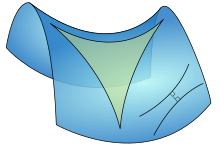
Differential geometry uses techniques of calculus and linear algebra to report problems in geometry.[95] Information technology has applications in physics,[96] econometrics,[97] and bioinformatics,[98] among others.
In particular, differential geometry is of importance to mathematical physics due to Albert Einstein's general relativity postulation that the universe is curved.[99] Differential geometry tin either exist intrinsic (pregnant that the spaces it considers are smooth manifolds whose geometric structure is governed by a Riemannian metric, which determines how distances are measured well-nigh each point) or extrinsic (where the object under study is a part of some ambient flat Euclidean space).[100]
Non-Euclidean geometry
Euclidean geometry was not the only historical form of geometry studied. Spherical geometry has long been used by astronomers, astrologers, and navigators.[101]
Immanuel Kant argued that there is only one, absolute, geometry, which is known to be true a priori by an inner kinesthesia of listen: Euclidean geometry was synthetic a priori.[102] This view was at first somewhat challenged by thinkers such every bit Saccheri, and so finally overturned by the revolutionary discovery of non-Euclidean geometry in the works of Bolyai, Lobachevsky, and Gauss (who never published his theory).[103] They demonstrated that ordinary Euclidean space is simply i possibility for development of geometry. A broad vision of the subject of geometry was then expressed by Riemann in his 1867 inauguration lecture Über dice Hypothesen, welche der Geometrie zu Grunde liegen (On the hypotheses on which geometry is based),[104] published just after his decease. Riemann'due south new idea of infinite proved crucial in Albert Einstein's general relativity theory. Riemannian geometry, which considers very general spaces in which the notion of length is defined, is a mainstay of modern geometry.[81]
Topology

Topology is the field concerned with the properties of continuous mappings,[105] and can be considered a generalization of Euclidean geometry.[106] In practice, topology often means dealing with large-scale properties of spaces, such as connectedness and compactness.[l]
The field of topology, which saw massive development in the 20th century, is in a technical sense a type of transformation geometry, in which transformations are homeomorphisms.[107] This has oft been expressed in the form of the saying 'topology is condom-sheet geometry'. Subfields of topology include geometric topology, differential topology, algebraic topology and general topology.[108]
Algebraic geometry

The field of algebraic geometry adult from the Cartesian geometry of co-ordinates.[109] It underwent periodic periods of growth, accompanied by the creation and study of projective geometry, birational geometry, algebraic varieties, and commutative algebra, amidst other topics.[110] From the late 1950s through the mid-1970s it had undergone major foundational evolution, largely due to work of Jean-Pierre Serre and Alexander Grothendieck.[110] This led to the introduction of schemes and greater accent on topological methods, including various cohomology theories. One of 7 Millennium Prize problems, the Hodge conjecture, is a question in algebraic geometry.[111] Wiles' proof of Fermat'southward Last Theorem uses advanced methods of algebraic geometry for solving a long-standing problem of number theory.
In full general, algebraic geometry studies geometry through the use of concepts in commutative algebra such as multivariate polynomials.[112] It has applications in many areas, including cryptography[113] and string theory.[114]
Complex geometry
Circuitous geometry studies the nature of geometric structures modelled on, or arising out of, the complex airplane.[115] [116] [117] Complex geometry lies at the intersection of differential geometry, algebraic geometry, and analysis of several complex variables, and has institute applications to cord theory and mirror symmetry.[118]
Complex geometry first appeared as a distinct area of report in the work of Bernhard Riemann in his study of Riemann surfaces.[119] [120] [121] Work in the spirit of Riemann was carried out by the Italian school of algebraic geometry in the early 1900s. Contemporary treatment of circuitous geometry began with the piece of work of Jean-Pierre Serre, who introduced the concept of sheaves to the subject area, and illuminated the relations betwixt complex geometry and algebraic geometry.[122] [123] The primary objects of report in circuitous geometry are circuitous manifolds, circuitous algebraic varieties, and complex analytic varieties, and holomorphic vector bundles and coherent sheaves over these spaces. Special examples of spaces studied in complex geometry include Riemann surfaces, and Calabi–Yau manifolds, and these spaces find uses in string theory. In particular, worldsheets of strings are modelled past Riemann surfaces, and superstring theory predicts that the actress six dimensions of ten dimensional spacetime may be modelled by Calabi–Yau manifolds.
Discrete geometry
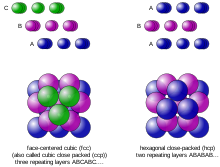
Discrete geometry is a subject that has close connections with convex geometry.[124] [125] [126] It is concerned mainly with questions of relative position of simple geometric objects, such as points, lines and circles. Examples include the report of sphere packings, triangulations, the Kneser-Poulsen conjecture, etc.[127] [128] It shares many methods and principles with combinatorics.
Computational geometry
Computational geometry deals with algorithms and their implementations for manipulating geometrical objects. Important problems historically have included the travelling salesman trouble, minimum spanning copse, hidden-line removal, and linear programming.[129]
Although beingness a young area of geometry, it has many applications in calculator vision, image processing, computer-aided design, medical imaging, etc.[130]
Geometric group theory

The Cayley graph of the complimentary group on two generators a and b
Geometric grouping theory uses big-scale geometric techniques to study finitely generated groups.[131] It is closely connected to low-dimensional topology, such as in Grigori Perelman'southward proof of the Geometrization conjecture, which included the proof of the Poincaré conjecture, a Millennium Prize Problem.[132]
Geometric group theory oft revolves around the Cayley graph, which is a geometric representation of a grouping. Other important topics include quasi-isometries, Gromov-hyperbolic groups, and right angled Artin groups.[131] [133]
Convex geometry
Convex geometry investigates convex shapes in the Euclidean space and its more abstract analogues, often using techniques of real analysis and discrete mathematics.[134] It has close connections to convex analysis, optimization and functional analysis and important applications in number theory.
Convex geometry dates back to antiquity.[134] Archimedes gave the first known precise definition of convexity. The isoperimetric trouble, a recurring concept in convex geometry, was studied past the Greeks equally well, including Zenodorus. Archimedes, Plato, Euclid, and later Kepler and Coxeter all studied convex polytopes and their backdrop. From the 19th century on, mathematicians have studied other areas of convex mathematics, including college-dimensional polytopes, volume and surface area of convex bodies, Gaussian curvature, algorithms, tilings and lattices.
Applications
Geometry has found applications in many fields, some of which are described below.
Art
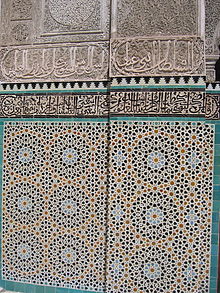
Bou Inania Madrasa, Fes, Morocco, zellige mosaic tiles forming elaborate geometric tessellations
Mathematics and art are related in a diverseness of ways. For instance, the theory of perspective showed that there is more to geometry than just the metric properties of figures: perspective is the origin of projective geometry.[135]
Artists have long used concepts of proportion in pattern. Vitruvius developed a complicated theory of ideal proportions for the human figure.[136] These concepts have been used and adapted past artists from Michelangelo to modern comic book artists.[137]
The gold ratio is a particular proportion that has had a controversial role in fine art. Oft claimed to be the most aesthetically pleasing ratio of lengths, it is frequently stated to be incorporated into famous works of art, though the most reliable and unambiguous examples were made deliberately by artists aware of this fable.[138]
Tilings, or tessellations, have been used in art throughout history. Islamic art makes frequent utilize of tessellations, as did the art of Chiliad. C. Escher.[139] Escher'southward work likewise made utilize of hyperbolic geometry.
Cézanne advanced the theory that all images tin be congenital up from the sphere, the cone, and the cylinder. This is withal used in art theory today, although the exact list of shapes varies from writer to author.[140] [141]
Architecture
Geometry has many applications in architecture. In fact, it has been said that geometry lies at the core of architectural design.[142] [143] Applications of geometry to architecture include the use of projective geometry to create forced perspective,[144] the use of conic sections in amalgam domes and like objects,[91] the use of tessellations,[91] and the use of symmetry.[91]
Physics
The field of astronomy, especially as it relates to mapping the positions of stars and planets on the angelic sphere and describing the relationship between movements of celestial bodies, have served as an important source of geometric problems throughout history.[145]
Riemannian geometry and pseudo-Riemannian geometry are used in general relativity.[146] String theory makes employ of several variants of geometry,[147] as does quantum information theory.[148]
Other fields of mathematics
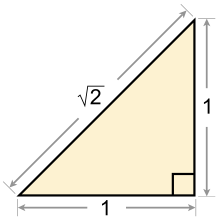
The Pythagoreans discovered that the sides of a triangle could have incommensurable lengths.
Calculus was strongly influenced by geometry.[30] For instance, the introduction of coordinates by René Descartes and the concurrent developments of algebra marked a new phase for geometry, since geometric figures such every bit aeroplane curves could now exist represented analytically in the grade of functions and equations. This played a fundamental role in the emergence of infinitesimal calculus in the 17th century. Analytic geometry continues to be a mainstay of pre-calculus and calculus curriculum.[149] [150]
Some other important area of awarding is number theory.[151] In ancient Greece the Pythagoreans considered the function of numbers in geometry. All the same, the discovery of incommensurable lengths contradicted their philosophical views.[152] Since the 19th century, geometry has been used for solving problems in number theory, for example through the geometry of numbers or, more recently, scheme theory, which is used in Wiles's proof of Fermat'south Final Theorem.[153]
See also
Lists
- List of geometers
- Category:Algebraic geometers
- Category:Differential geometers
- Category:Geometers
- Category:Topologists
- List of formulas in elementary geometry
- List of geometry topics
- List of important publications in geometry
- Lists of mathematics topics
- Descriptive geometry
- Finite geometry
- Flatland, a book written by Edwin Abbott Abbott nigh two- and 3-dimensional infinite, to understand the concept of four dimensions
- Listing of interactive geometry software
Other fields
- Molecular geometry
Notes
- ^ Until the 19th century, geometry was dominated by the supposition that all geometric constructions were Euclidean. In the 19th century and later, this was challenged by the development of hyperbolic geometry by Lobachevsky and other non-Euclidean geometries by Gauss and others. It was then realised that implicitly non-Euclidean geometry had appeared throughout history, including the piece of work of Desargues in the 17th century, all the mode back to the implicit use of spherical geometry to understand the Earth geodesy and to navigate the oceans since antiquity.
- ^ The ancient Greeks had some constructions using other instruments.
- ^ Vincenzo De Risi (2015). Mathematizing Space: The Objects of Geometry from Artifact to the Early Modern Age. Birkhäuser. pp. 1–. ISBN978-3-319-12102-iv.
- ^ a b Tabak, John (2014). Geometry: the linguistic communication of space and course. Infobase Publishing. p. fourteen. ISBN978-0-8160-4953-0.
- ^ Walter A. Meyer (2006). Geometry and Its Applications. Elsevier. ISBN978-0-08-047803-half dozen.
- ^ J. Friberg, "Methods and traditions of Babylonian mathematics. Plimpton 322, Pythagorean triples, and the Babylonian triangle parameter equations", Historia Mathematica, 8, 1981, pp. 277–318.
- ^ Neugebauer, Otto (1969) [1957]. "Chap. IV Egyptian Mathematics and Astronomy". The Verbal Sciences in Antiquity (two ed.). Dover Publications. pp. 71–96. ISBN978-0-486-22332-2. .
- ^ (Boyer 1991, "Egypt" p. nineteen)
- ^ Ossendrijver, Mathieu (29 January 2016). "Aboriginal Babylonian astronomers calculated Jupiter'due south position from the area under a time-velocity graph". Science. 351 (6272): 482–484. Bibcode:2016Sci...351..482O. doi:ten.1126/science.aad8085. PMID 26823423. S2CID 206644971.
- ^ Depuydt, Leo (ane January 1998). "Gnomons at Meroë and Early Trigonometry". The Journal of Egyptian Archaeology. 84: 171–180. doi:x.2307/3822211. JSTOR 3822211.
- ^ Slayman, Andrew (27 May 1998). "Neolithic Skywatchers". Archaeology Magazine Archive. Archived from the original on five June 2011. Retrieved 17 April 2011.
- ^ (Boyer 1991, "Ionia and the Pythagoreans" p. 43)
- ^ Eves, Howard, An Introduction to the History of Mathematics, Saunders, 1990, ISBN 0-03-029558-0.
- ^ Kurt Von Fritz (1945). "The Discovery of Incommensurability by Hippasus of Metapontum". The Annals of Mathematics.
- ^ James R. Choike (1980). "The Pentagram and the Discovery of an Irrational Number". The Two-Year College Mathematics Journal.
- ^ (Boyer 1991, "The Age of Plato and Aristotle" p. 92)
- ^ (Boyer 1991, "Euclid of Alexandria" p. 119)
- ^ (Boyer 1991, "Euclid of Alexandria" p. 104)
- ^ Howard Eves, An Introduction to the History of Mathematics, Saunders, 1990, ISBN 0-03-029558-0 p. 141: "No piece of work, except The Bible, has been more widely used...."
- ^ O'Connor, J.J.; Robertson, E.F. (February 1996). "A history of calculus". University of St Andrews. Archived from the original on 15 July 2007. Retrieved 7 August 2007.
- ^ Staal, Frits (1999). "Greek and Vedic Geometry". Journal of Indian Philosophy. 27 (i–2): 105–127. doi:x.1023/A:1004364417713. S2CID 170894641.
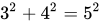
- ^ Pythagorean triples are triples of integers with the holding: . Thus, , , etc.
- ^ (Cooke 2005, p. 198): "The arithmetic content of the Śulva Sūtras consists of rules for finding Pythagorean triples such as (iii, 4, 5), (five, 12, 13), (8, 15, 17), and (12, 35, 37). Information technology is not certain what applied employ these arithmetic rules had. The best conjecture is that they were part of religious ritual. A Hindu home was required to have three fires burning at iii unlike altars. The iii altars were to be of dissimilar shapes, but all three were to have the same area. These conditions led to sure "Diophantine" bug, a particular case of which is the generation of Pythagorean triples, so as to make one square integer equal to the sum of two others."
- ^ (Hayashi 2005, p. 371)
- ^ a b (Hayashi 2003, pp. 121–122)
- ^ R. Rashed (1994), The development of Arabic mathematics: between arithmetic and algebra, p. 35 London
- ^ (Boyer 1991, "The Standard arabic Hegemony" pp. 241–242) "Omar Khayyam (c. 1050–1123), the "tent-maker," wrote an Algebra that went beyond that of al-Khwarizmi to include equations of 3rd degree. Like his Arab predecessors, Omar Khayyam provided for quadratic equations both arithmetic and geometric solutions; for general cubic equations, he believed (mistakenly, as the 16th century afterwards showed), arithmetic solutions were impossible; hence he gave only geometric solutions. The scheme of using intersecting conics to solve cubics had been used earlier by Menaechmus, Archimedes, and Alhazan, but Omar Khayyam took the praiseworthy step of generalizing the method to comprehend all third-caste equations (having positive roots). .. For equations of higher caste than three, Omar Khayyam evidently did not envision similar geometric methods, for space does not contain more than 3 dimensions, ... One of the most fruitful contributions of Arabic eclecticism was the trend to close the gap between numerical and geometric algebra. The decisive step in this direction came much later on with Descartes, but Omar Khayyam was moving in this management when he wrote, "Whoever thinks algebra is a play a trick on in obtaining unknowns has thought it in vain. No attention should be paid to the fact that algebra and geometry are different in appearance. Algebras are geometric facts which are proved."".
- ^ O'Connor, John J.; Robertson, Edmund F. "Al-Mahani". MacTutor History of Mathematics annal. University of St Andrews.
- ^ O'Connor, John J.; Robertson, Edmund F. "Al-Sabi Thabit ibn Qurra al-Harrani". MacTutor History of Mathematics annal. University of St Andrews.
- ^ O'Connor, John J.; Robertson, Edmund F. "Omar Khayyam". MacTutor History of Mathematics archive. University of St Andrews.
- ^ Boris A. Rosenfeld and Adolf P. Youschkevitch (1996), "Geometry", in Roshdi Rashed, ed., Encyclopedia of the History of Arabic Science, Vol. ii, pp. 447–494 [470], Routledge, London and New York:
"3 scientists, Ibn al-Haytham, Khayyam, and al-Tusi, had made the about considerable contribution to this co-operative of geometry whose importance came to be completely recognized but in the 19th century. In essence, their propositions concerning the properties of quadrangles which they considered, bold that some of the angles of these figures were acute of obtuse, embodied the first few theorems of the hyperbolic and the elliptic geometries. Their other proposals showed that various geometric statements were equivalent to the Euclidean postulate V. Information technology is extremely important that these scholars established the mutual connection betwixt this postulate and the sum of the angles of a triangle and a quadrangle. Past their works on the theory of parallel lines Arab mathematicians straight influenced the relevant investigations of their European counterparts. The beginning European attempt to prove the postulate on parallel lines—made by Witelo, the Polish scientists of the 13th century, while revising Ibn al-Haytham'due south Volume of Optics (Kitab al-Manazir)—was undoubtedly prompted by Arabic sources. The proofs put forward in the 14th century by the Jewish scholar Levi ben Gerson, who lived in southern France, and by the above-mentioned Alfonso from Espana direct border on Ibn al-Haytham'due south sit-in. Above, nosotros take demonstrated that Pseudo-Tusi's Exposition of Euclid had stimulated both J. Wallis's and G. Saccheri's studies of the theory of parallel lines."
- ^ a b Carl B. Boyer (2012). History of Analytic Geometry. Courier Corporation. ISBN978-0-486-15451-0.
- ^ C.H. Edwards Jr. (2012). The Historical Development of the Calculus. Springer Scientific discipline & Business organization Media. p. 95. ISBN978-i-4612-6230-5.
- ^ Judith V. Field; Jeremy Gray (2012). The Geometrical Work of Girard Desargues. Springer Science & Business Media. p. 43. ISBN978-i-4613-8692-six.
- ^ C. R. Wylie (2011). Introduction to Projective Geometry. Courier Corporation. ISBN978-0-486-14170-1.
- ^ Jeremy Gray (2011). Worlds Out of Nothing: A Grade in the History of Geometry in the 19th Century. Springer Scientific discipline & Business Media. ISBN978-0-85729-060-one.
- ^ Eduardo Bayro-Corrochano (2018). Geometric Algebra Applications Vol. I: Computer Vision, Graphics and Neurocomputing. Springer. p. four. ISBN978-3-319-74830-half dozen.
- ^ a b Schmidt, W., Houang, R., & Cogan, L. (2002). "A coherent curriculum". American Educator, 26(two), 1–18.
- ^ Morris Kline (1990). Mathematical Idea From Aboriginal to Modern Times: Volume 3. US: Oxford University Press. pp. 1010–. ISBN978-0-nineteen-506137-half dozen.
- ^ Victor J. Katz (2000). Using History to Teach Mathematics: An International Perspective. Cambridge University Printing. pp. 45–. ISBN978-0-88385-163-0.
- ^ David Berlinski (2014). The Rex of Infinite Space: Euclid and His Elements . Basic Books. ISBN978-0-465-03863-3.
- ^ a b Robin Hartshorne (2013). Geometry: Euclid and Across. Springer Scientific discipline & Concern Media. pp. 29–. ISBN978-0-387-22676-7.
- ^ Pat Herbst; Taro Fujita; Stefan Halverscheid; Michael Weiss (2017). The Learning and Teaching of Geometry in Secondary Schools: A Modeling Perspective. Taylor & Francis. pp. 20–. ISBN978-1-351-97353-three.
- ^ I.M. Yaglom (2012). A Simple Non-Euclidean Geometry and Its Physical Basis: An Unproblematic Business relationship of Galilean Geometry and the Galilean Principle of Relativity. Springer Science & Business concern Media. pp. 6–. ISBN978-i-4612-6135-3.
- ^ Audun Holme (2010). Geometry: Our Cultural Heritage. Springer Science & Business Media. pp. 254–. ISBN978-3-642-14441-7.
- ^ a b c d due east Euclid's Elements – All 13 books in ane volume, Based on Heath'due south translation, Greenish Panthera leo Press ISBN 1-888009-18-7.
- ^ Gerla, 1000. (1995). "Pointless Geometries" (PDF). In Buekenhout, F.; Kantor, Westward. (eds.). Handbook of incidence geometry: buildings and foundations. N-Holland. pp. 1015–1031. Archived from the original (PDF) on 17 July 2011.
- ^ Clark, Bowman L. (January 1985). "Individuals and Points". Notre Dame Journal of Formal Logic. 26 (1): 61–75. doi:10.1305/ndjfl/1093870761.
- ^ John Casey (1885). Analytic Geometry of the Point, Line, Circle, and Conic Sections.
- ^ Buekenhout, Francis (1995), Handbook of Incidence Geometry: Buildings and Foundations, Elsevier B.V.
- ^ "geodesic – definition of geodesic in English from the Oxford dictionary". OxfordDictionaries.com. Archived from the original on 15 July 2016. Retrieved 20 Jan 2016.
- ^ a b c d eastward Munkres, James R. Topology. Vol. 2. Upper Saddle River: Prentice Hall, 2000.
- ^ Szmielew, Wanda. From affine to Euclidean geometry: An axiomatic arroyo. Springer, 1983.
- ^ Ahlfors, Lars V. Circuitous analysis: an introduction to the theory of analytic functions of one complex variable. New York; London (1953).
- ^ Sidorov, L.A. (2001) [1994]. "Angle". Encyclopedia of Mathematics. Ems Printing.
- ^ Gelʹfand, Izrailʹ Moiseevič, and Mark Saul. "Trigonometry." Trigonometry. Birkhäuser Boston, 2001. 1–20.
- ^ Stewart, James (2012). Calculus: Early Transcendentals, seventh ed., Brooks Cole Cengage Learning. ISBN 978-0-538-49790-9
- ^ Jost, Jürgen (2002). Riemannian Geometry and Geometric Analysis. Berlin: Springer-Verlag. ISBN978-3-540-42627-1. .
- ^ Baker, Henry Frederick. Principles of geometry. Vol. 2. Cup Annal, 1954.
- ^ a b c Do Carmo, Manfredo Perdigao, and Manfredo Perdigao Do Carmo. Differential geometry of curves and surfaces. Vol. 2. Englewood Cliffs: Prentice-hall, 1976.
- ^ a b Mumford, David (1999). The Ruby-red Book of Varieties and Schemes Includes the Michigan Lectures on Curves and Their Jacobians (second ed.). Springer-Verlag. ISBN978-3-540-63293-i. Zbl 0945.14001.
- ^ Briggs, William Fifty., and Lyle Cochran Calculus. "Early Transcendentals." ISBN 978-0-321-57056-vii.
- ^ Yau, Shing-Tung; Nadis, Steve (2010). The Shape of Inner Space: String Theory and the Geometry of the Universe's Hidden Dimensions. Basic Books. ISBN 978-0-465-02023-2.
- ^ a b Steven A. Treese (2018). History and Measurement of the Base and Derived Units. Springer International Publishing. pp. 101–. ISBN978-iii-319-77577-7.
- ^ James Due west. Cannon (2017). Geometry of Lengths, Areas, and Volumes. American Mathematical Soc. p. eleven. ISBN978-1-4704-3714-5.
- ^ Gilbert Strang (1991). Calculus. SIAM. ISBN978-0-9614088-ii-four.
- ^ H. S. Acquit (2002). A Primer of Lebesgue Integration. Bookish Press. ISBN978-0-12-083971-1.
- ^ Dmitri Burago, Yu D Burago, Sergei Ivanov, A Grade in Metric Geometry, American Mathematical Society, 2001, ISBN 0-8218-2129-6.
- ^ Wald, Robert Yard. (1984). General Relativity. University of Chicago Press. ISBN978-0-226-87033-5.
- ^ Terence Tao (2011). An Introduction to Measure Theory. American Mathematical Soc. ISBN978-0-8218-6919-ii.
- ^ Shlomo Libeskind (2008). Euclidean and Transformational Geometry: A Deductive Research. Jones & Bartlett Learning. p. 255. ISBN978-0-7637-4366-6.
- ^ Marking A. Freitag (2013). Mathematics for Elementary School Teachers: A Process Approach. Cengage Learning. p. 614. ISBN978-0-618-61008-2.
- ^ George E. Martin (2012). Transformation Geometry: An Introduction to Symmetry. Springer Science & Business organisation Media. ISBN978-ane-4612-5680-9.
- ^ Marker Blacklock (2018). The Emergence of the Fourth Dimension: Higher Spatial Thinking in the Fin de Siècle. Oxford University Press. ISBN978-0-nineteen-875548-7.
- ^ Charles Jasper Joly (1895). Papers. The Academy. pp. 62–.
- ^ Roger Temam (2013). Infinite-Dimensional Dynamical Systems in Mechanics and Physics. Springer Science & Business concern Media. p. 367. ISBN978-one-4612-0645-3.
- ^ Bill Jacob; Tsit-Yuen Lam (1994). Recent Advances in Real Algebraic Geometry and Quadratic Forms: Proceedings of the RAGSQUAD Year, Berkeley, 1990–1991. American Mathematical Soc. p. 111. ISBN978-0-8218-5154-eight.
- ^ Ian Stewart (2008). Why Dazzler Is Truth: A History of Symmetry. Basic Books. p. xiv. ISBN978-0-465-08237-seven.
- ^ Stakhov Alexey (2009). Mathematics Of Harmony: From Euclid To Contemporary Mathematics And Computer Science. Earth Scientific. p. 144. ISBN978-981-4472-57-nine.
- ^ Werner Hahn (1998). Symmetry equally a Developmental Principle in Nature and Art. Globe Scientific. ISBN978-981-02-2363-2.
- ^ Brian J. Cantwell (2002). Introduction to Symmetry Analysis. Cambridge Academy Press. p. 34. ISBN978-1-139-43171-2.
- ^ B. Rosenfeld; Bill Wiebe (2013). Geometry of Lie Groups. Springer Science & Business Media. pp. 158ff. ISBN978-i-4757-5325-7.
- ^ a b Peter Pesic (2007). Across Geometry: Classic Papers from Riemann to Einstein. Courier Corporation. ISBN978-0-486-45350-7.
- ^ Michio Kaku (2012). Strings, Conformal Fields, and Topology: An Introduction. Springer Science & Business organization Media. p. 151. ISBN978-1-4684-0397-8.
- ^ Mladen Bestvina; Michah Sageev; Karen Vogtmann (2014). Geometric Group Theory. American Mathematical Soc. p. 132. ISBN978-1-4704-1227-ii.
- ^ W-H. Steeb (1996). Continuous Symmetries, Prevarication Algebras, Differential Equations and Calculator Algebra. World Scientific Publishing Company. ISBN978-981-310-503-4.
- ^ Charles W. Misner (2005). Directions in General Relativity: Volume 1: Proceedings of the 1993 International Symposium, Maryland: Papers in Honor of Charles Misner. Cambridge University Press. p. 272. ISBN978-0-521-02139-five.
- ^ Linnaeus Wayland Dowling (1917). Projective Geometry. McGraw-Hill book Company, Incorporated. p. 10.
- ^ G. Gierz (2006). Bundles of Topological Vector Spaces and Their Duality. Springer. p. 252. ISBN978-3-540-39437-2.
- ^ Robert E. Butts; J.R. Brown (2012). Constructivism and Scientific discipline: Essays in Recent German language Philosophy. Springer Scientific discipline & Business Media. pp. 127–. ISBN978-94-009-0959-five.
- ^ Scientific discipline. Moses King. 1886. pp. 181–.
- ^ W. Abbot (2013). Practical Geometry and Applied science Graphics: A Textbook for Engineering and Other Students. Springer Scientific discipline & Business Media. pp. 6–. ISBN978-94-017-2742-6.
- ^ a b c d George L. Hersey (2001). Architecture and Geometry in the Age of the Bizarre. Academy of Chicago Press. ISBN978-0-226-32783-9.
- ^ P. Vanícek; East.J. Krakiwsky (2015). Geodesy: The Concepts. Elsevier. p. 23. ISBN978-1-4832-9079-ix.
- ^ Russell M. Cummings; Scott A. Morton; William H. Mason; David R. McDaniel (2015). Applied Computational Aerodynamics. Cambridge Academy Press. p. 449. ISBN978-1-107-05374-8.
- ^ Roy Williams (1998). Geometry of Navigation. Horwood Pub. ISBN978-i-898563-46-4.
- ^ Gerard Walschap (2015). Multivariable Calculus and Differential Geometry. De Gruyter. ISBN978-3-eleven-036954-0.
- ^ Harley Flemish region (2012). Differential Forms with Applications to the Physical Sciences. Courier Corporation. ISBN978-0-486-13961-6.
- ^ Paul Marriott; Marker Salmon (2000). Applications of Differential Geometry to Econometrics. Cambridge University Press. ISBN978-0-521-65116-5.
- ^ Matthew He; Sergey Petoukhov (2011). Mathematics of Bioinformatics: Theory, Methods and Applications. John Wiley & Sons. p. 106. ISBN978-i-118-09952-0.
- ^ P.A.M. Dirac (2016). Full general Theory of Relativity. Princeton Academy Printing. ISBN978-1-4008-8419-three.
- ^ Nihat Ay; Jürgen Jost; Hông Vân Lê; Lorenz Schwachhöfer (2017). Data Geometry. Springer. p. 185. ISBN978-3-319-56478-4.
- ^ Boris A. Rosenfeld (2012). A History of Non-Euclidean Geometry: Development of the Concept of a Geometric Space. Springer Science & Business Media. ISBN978-ane-4419-8680-1.
- ^ Kline (1972) "Mathematical thought from aboriginal to mod times", Oxford University Press, p. 1032. Kant did not reject the logical (analytic a priori) possibility of non-Euclidean geometry, run across Jeremy Gray, "Ideas of Space Euclidean, Not-Euclidean, and Relativistic", Oxford, 1989; p. 85. Some have unsaid that, in lite of this, Kant had in fact predicted the development of non-Euclidean geometry, cf. Leonard Nelson, "Philosophy and Axiomatics," Socratic Method and Critical Philosoph, Dover, 1965, p. 164.
- ^ Duncan 1000'Laren Immature Sommerville (1919). Elements of Not-Euclidean Geometry ... Open up Courtroom. pp. 15ff.
- ^ "Ueber die Hypothesen, welche der Geometrie zu Grunde liegen". Archived from the original on 18 March 2016.
- ^ Martin D. Crossley (2011). Essential Topology. Springer Science & Business Media. ISBN978-1-85233-782-7.
- ^ Charles Nash; Siddhartha Sen (1988). Topology and Geometry for Physicists. Elsevier. p. 1. ISBN978-0-08-057085-3.
- ^ George E. Martin (1996). Transformation Geometry: An Introduction to Symmetry. Springer Science & Business organization Media. ISBN978-0-387-90636-2.
- ^ J. P. May (1999). A Concise Course in Algebraic Topology. University of Chicago Press. ISBN978-0-226-51183-2.
- ^ The Encyclopedia Americana: A Universal Reference Library Comprising the Arts and Sciences, Literature, History, Biography, Geography, Commerce, Etc., of the World. Scientific American Compiling Department. 1905. pp. 489–.
- ^ a b Suzanne C. Dieudonne (1985). History Algebraic Geometry. CRC Printing. ISBN978-0-412-99371-8.
- ^ James Carlson; James A. Carlson; Arthur Jaffe; Andrew Wiles (2006). The Millennium Prize Issues. American Mathematical Soc. ISBN978-0-8218-3679-viii.
- ^ Robin Hartshorne (2013). Algebraic Geometry. Springer Scientific discipline & Concern Media. ISBN978-1-4757-3849-0.
- ^ Everett W. Howe; Kristin E. Lauter; Judy L. Walker (2017). Algebraic Geometry for Coding Theory and Cryptography: IPAM, Los Angeles, CA, February 2016. Springer. ISBN978-3-319-63931-4.
- ^ Marcos Marino; Michael Thaddeus; Ravi Vakil (2008). Enumerative Invariants in Algebraic Geometry and String Theory: Lectures given at the C.I.M.Due east. Summer School held in Cetraro, Italy, June 6–11, 2005. Springer. ISBN978-3-540-79814-nine.
- ^ Huybrechts, D. (2006). Complex geometry: an introduction. Springer Science & Business Media.
- ^ Griffiths, P., & Harris, J. (2014). Principles of algebraic geometry. John Wiley & Sons.
- ^ Wells, R. O. N., & García-Prada, O. (1980). Differential analysis on complex manifolds (Vol. 21980). New York: Springer.
- ^ Hori, 1000., Thomas, R., Katz, South., Vafa, C., Pandharipande, R., Klemm, A., ... & Zaslow, E. (2003). Mirror symmetry (Vol. 1). American Mathematical Soc.
- ^ Forster, O. (2012). Lectures on Riemann surfaces (Vol. 81). Springer Scientific discipline & Concern Media.
- ^ Miranda, R. (1995). Algebraic curves and Riemann surfaces (Vol. 5). American Mathematical Soc.
- ^ Donaldson, S. (2011). Riemann surfaces. Oxford University Press.
- ^ Serre, J. P. (1955). Faisceaux algébriques cohérents. Annals of Mathematics, 197–278.
- ^ Serre, J. P. (1956). Géométrie algébrique et géométrie analytique. In Annales de l'Institut Fourier (vol. 6, pp. 1–42).
- ^ Jiří Matoušek (2013). Lectures on Detached Geometry. Springer Science & Concern Media. ISBN978-1-4613-0039-7.
- ^ Chuanming Zong (2006). The Cube – A Window to Convex and Detached Geometry. Cambridge Academy Printing. ISBN978-0-521-85535-eight.
- ^ Peter M. Gruber (2007). Convex and Discrete Geometry. Springer Science & Business organization Media. ISBN978-3-540-71133-9.
- ^ Satyan L. Devadoss; Joseph O'Rourke (2011). Detached and Computational Geometry. Princeton Academy Printing. ISBN978-1-4008-3898-one.
- ^ Károly Bezdek (2010). Classical Topics in Discrete Geometry. Springer Science & Concern Media. ISBN978-1-4419-0600-7.
- ^ Franco P. Preparata; Michael I. Shamos (2012). Computational Geometry: An Introduction. Springer Science & Business Media. ISBN978-ane-4612-1098-half dozen.
- ^ Xianfeng David Gu; Shing-Tung Yau (2008). Computational Conformal Geometry. International Press. ISBN978-1-57146-171-i.
- ^ a b Clara Löh (2017). Geometric Group Theory: An Introduction. Springer. ISBN978-3-319-72254-2.
- ^ John Morgan; Gang Tian (2014). The Geometrization Conjecture. American Mathematical Soc. ISBN978-0-8218-5201-9.
- ^ Daniel T. Wise (2012). From Riches to Raags: 3-Manifolds, Correct-Angled Artin Groups, and Cubical Geometry: 3-manifolds, Correct-angled Artin Groups, and Cubical Geometry. American Mathematical Soc. ISBN978-0-8218-8800-one.
- ^ a b Gerard Meurant (2014). Handbook of Convex Geometry. Elsevier Science. ISBN978-0-08-093439-6.
- ^ Jürgen Richter-Gebert (2011). Perspectives on Projective Geometry: A Guided Bout Through Real and Complex Geometry. Springer Science & Concern Media. ISBN978-3-642-17286-1.
- ^ Kimberly Elam (2001). Geometry of Design: Studies in Proportion and Composition. Princeton Architectural Printing. ISBN978-1-56898-249-6.
- ^ Brad J. Guigar (2004). The Everything Cartooning Book: Create Unique And Inspired Cartoons For Fun And Profit. Adams Media. pp. 82–. ISBN978-1-4405-2305-2.
- ^ Mario Livio (2008). The Golden Ratio: The Story of PHI, the World's Most Amazing Number. Crown/Archetype. p. 166. ISBN978-0-307-48552-6.
- ^ Michele Emmer; Doris Schattschneider (2007). M. C. Escher's Legacy: A Centennial Celebration. Springer. p. 107. ISBN978-three-540-28849-seven.
- ^ Robert Capitolo; Ken Schwab (2004). Drawing Course 101 . Sterling Publishing Company, Inc. p. 22. ISBN978-1-4027-0383-6.
- ^ Phyllis Gelineau (2011). Integrating the Arts Across the Elementary School Curriculum. Cengage Learning. p. 55. ISBN978-1-111-30126-ii.
- ^ Cristiano Ceccato; Lars Hesselgren; Marker Pauly; Helmut Pottmann, Johannes Wallner (2016). Advances in Architectural Geometry 2010. Birkhäuser. p. vi. ISBN978-3-99043-371-3.
- ^ Helmut Pottmann (2007). Architectural geometry. Bentley Establish Press. ISBN978-1-934493-04-v.
- ^ Marian Moffett; Michael W. Fazio; Lawrence Wodehouse (2003). A World History of Architecture. Laurence Male monarch Publishing. p. 371. ISBN978-1-85669-371-4.
- ^ Robin Thousand. Green; Robin Michael Light-green (1985). Spherical Astronomy. Cambridge University Press. p. 1. ISBN978-0-521-31779-v.
- ^ Dmitriĭ Vladimirovich Alekseevskiĭ (2008). Recent Developments in Pseudo-Riemannian Geometry. European Mathematical Society. ISBN978-iii-03719-051-7.
- ^ Shing-Tung Yau; Steve Nadis (2010). The Shape of Inner Space: String Theory and the Geometry of the Universe's Hidden Dimensions. Bones Books. ISBN978-0-465-02266-3.
- ^ Bengtsson, Ingemar; Życzkowski, Karol (2017). Geometry of Breakthrough States: An Introduction to Quantum Entanglement (2nd ed.). Cambridge University Press. ISBN978-1-107-02625-4. OCLC 1004572791.
- ^ Harley Flanders; Justin J. Price (2014). Calculus with Analytic Geometry. Elsevier Science. ISBN978-1-4832-6240-6.
- ^ Jon Rogawski; Colin Adams (2015). Calculus. W. H. Freeman. ISBN978-1-4641-7499-5.
- ^ Álvaro Lozano-Robledo (2019). Number Theory and Geometry: An Introduction to Arithmetic Geometry. American Mathematical Soc. ISBN978-1-4704-5016-8.
- ^ Arturo Sangalli (2009). Pythagoras' Revenge: A Mathematical Mystery . Princeton University Press. p. 57. ISBN978-0-691-04955-7.
- ^ Gary Cornell; Joseph H. Silverman; Glenn Stevens (2013). Modular Forms and Fermat's Last Theorem. Springer Science & Business Media. ISBN978-1-4612-1974-3.




Sources
- Boyer, C.B. (1991) [1989]. A History of Mathematics (Second edition, revised by Uta C. Merzbach ed.). New York: Wiley. ISBN978-0-471-54397-8.
- Cooke, Roger (2005). The History of Mathematics. New York: Wiley-Interscience. ISBN978-0-471-44459-6.
- Hayashi, Takao (2003). "Indian Mathematics". In Grattan-Guinness, Ivor (ed.). Companion Encyclopedia of the History and Philosophy of the Mathematical Sciences. Vol. 1. Baltimore, Dr.: The Johns Hopkins Academy Printing. pp. 118–130. ISBN978-0-8018-7396-half-dozen.
- Hayashi, Takao (2005). "Indian Mathematics". In Flood, Gavin (ed.). The Blackwell Companion to Hinduism. Oxford: Basil Blackwell. pp. 360–375. ISBN978-1-4051-3251-0.
- Nikolai I. Lobachevsky (2010). Pangeometry. Heritage of European Mathematics Serial. Vol. iv. translator and editor: A. Papadopoulos. European Mathematical Society.
Farther reading
- Jay Kappraff (2014). A Participatory Arroyo to Modern Geometry. Earth Scientific Publishing. doi:10.1142/8952. ISBN978-981-4556-70-five.
- Leonard Mlodinow (2002). Euclid's Window – The Story of Geometry from Parallel Lines to Hyperspace (Great britain ed.). Allen Lane. ISBN978-0-7139-9634-0.
External links
 | Wikibooks has more on the topic of: Geometry |
. Encyclopædia Britannica. Vol. 11 (11th ed.). 1911. pp. 675–736.
- A geometry class from Wikiversity
- Unusual Geometry Bug
- The Math Forum – Geometry
- The Math Forum – K–12 Geometry
- The Math Forum – College Geometry
- The Math Forum – Advanced Geometry
- Nature Precedings – Pegs and Ropes Geometry at Stonehenge
- The Mathematical Atlas – Geometric Areas of Mathematics
- "4000 Years of Geometry", lecture by Robin Wilson given at Gresham College, 3 Oct 2007 (available for MP3 and MP4 download as well equally a text file)
- Finitism in Geometry at the Stanford Encyclopedia of Philosophy
- The Geometry Junkyard
- Interactive geometry reference with hundreds of applets
- Dynamic Geometry Sketches (with some Student Explorations)
- Geometry classes at Khan Academy
Source: https://en.wikipedia.org/wiki/Geometry
0 Response to "Word and Number and Symbol and Art and Geometric Pattern Recognition Middle School Book"
Post a Comment